With the ever increasing cost of groceries, you may be wondering how many meat birds per person for a year? Raising meat for your family is a great way to provide high quality meat for a fraction of grocery store prices. It’s also a great way to ensure you are able to feed your family no matter what is going on at the grocery store.
However, deciding how much meat you may need for your family can be overwhelming. Find out how much meat you’ll actually need to feed your family for a year.
The Simple Formula for How Many Meat Birds Per Person for A Year?
A general rule of how many meat birds per person for a year is ¼ bird per person per week or 8-12 meat birds per person per year.
An average whole chicken yields 2.5 to 5 pounds depending on the breed. A Cornish Cross will be a larger bird and heritage breeds will be smaller.
One whole bird will feed an average of 4 to 6 people depending on its size. This will also depend on whether you are serving the chicken whole, or using parts of the bird for a meal.
This average will also fluctuate if you have people in your family that eat larger servings. As a mom of 5, I have 3 growing boys and a husband that can eat a considerable amount.
If you also have a large family with big eaters you will need to plan on raising the higher in of the average I mentioned above.
How Much Chicken Does the Average Person Eat?
The average American eats around 81 pounds of chicken per person per year. That’s a lot of chicken! But you have to realize that it’s chicken in all forms. Soups, stews, etc.
For a home-raised whole bird, there is an average of 4 pounds of usable meat on the bird. If you do the math 81 pounds divided by 4 that’s around 20 ¼ chickens per person per year.
That’s if you’re replacing ALL forms of chicken you consume. If you ever eat out or purchase chicken other than eating from home that is factored into your 20 ¼ chickens per year.
If you are homesteading (especially with a full time job), you know that to entirely replace your diet is not realistic. There will be times when you’re unable to eat something you grew yourself at home.
Let’s say you’re on a vacation in Florida, and cooking meals isn’t your idea of relaxing. You might eat out.
Perhaps, you do plan on cooking on your vacation, but you don’t want to bring your food with you on the trip. This can be a real problem for a large family with limited vehicle space. You will likely purchase food from a local grocery store.
This is just one scenario, but there are many I could explore.
Scenario 1: Supplemental Chicken (1–2 meals per week).
If you’re cooking at home regularly and eating other meats as well as chicken, you will average around 1-2 chicken meals per week. For this amount of chicken consumption you can plan on raising:
- 8–12 birds per person annually
Scenario 2: Primary Protein Source
If chicken is your primary source of protein, then you will be consuming more than the average family. If this is your lifestyle you can plan on:
- 15–20 birds per person annually
Scenario 3: Full Replacement of Store Chicken
If you want to fully replace all forms of store bought chicken and be completely self-reliant, you can plan on:
- 20–25 birds per person annually
For our family of 7, we raise 100-125 birds per year. This is usually more than enough to meet our needs, but allows us to share with our family if needed.
How Much Freezer Space Do You Need?
If you’re raising meat for your family, you must take freezer space into consideration.
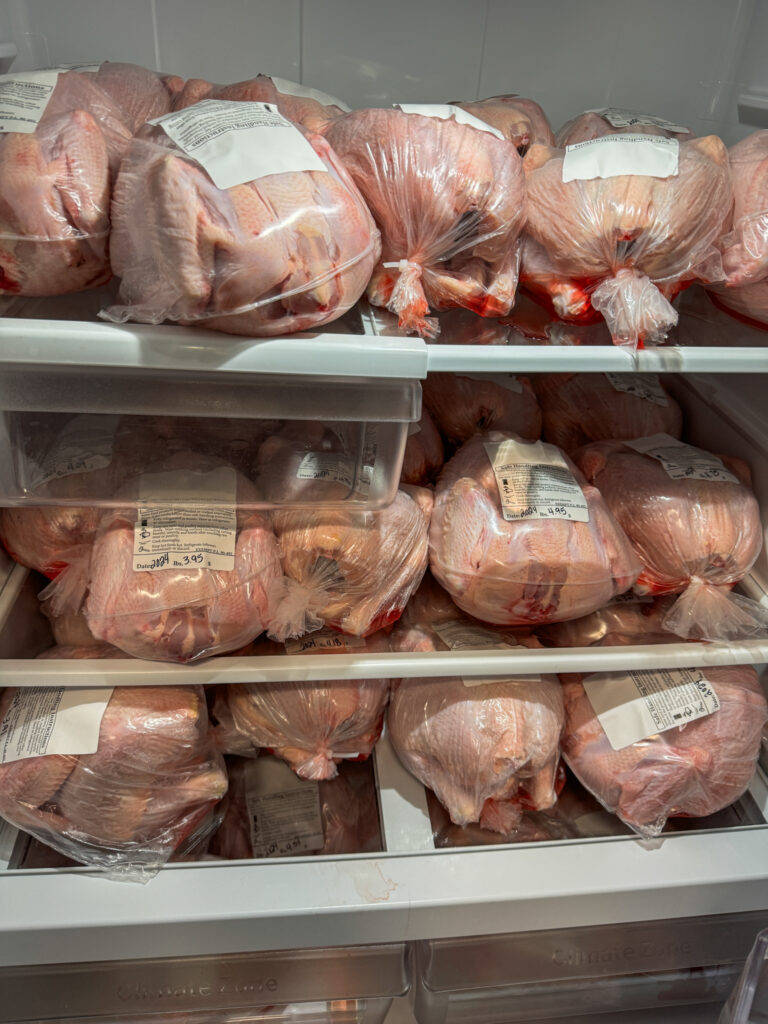
1 cubic foot of freezer space will hold 35-40 pounds of packaged meat. With an average of 2.5-5 pounds per bird you can plan on 7-14 birds per cubic foot.
However, it’s best to plan on 7 whole processed birds per cubic foot of space. A small 5-7 cu. ft freezer can hold 30-50 whole birds. A medium 8-14 cu. ft freezer can hold can hold 60-100 whole birds, and a large 15-25 cu. ft freezer can hold 100-200 whole birds.
If you need a good visual, a processed, bagged chicken is equivalent to one gallon volume.
Also cutting up and packaging chickens will help with freezer space because the chickens can be arranged.
So for example: A family of 5 raising 50 birds = 5 cubic feet of freezer space.
More Articles You’ll Love
- How to build an easy DIY bulk chicken waterer
- 21 BEST protein sources for backyard chickens
- The top 20 BEST egg-laying chickens
- How to process a chicken
- Best chicken coop bedding
- Setting up a chicken brooder
- Raising meat birds
- Cornish Rock Cross chickens: An honest review
Cost Breakdown Per Person
Feed cost-(approx. 15–18 lbs feed per Cornish Cross) I feed closer to 15 pounds of feed per bird.
Bedding-Bedding will vary depending on what you use. For your brooder you can use wood shavings, or straw. We have also had great results with newspaper. Many sites will warn against newspaper as it can damage the legs of baby chicks.
However, we’ve never encountered that problem, and actually had a lower mortality rate due to our chicks not eating wood shavings.
Processing supplies– Very basic level processing is going to require a very large pot for scalding, a heat source for heating the pot, a thermometer, a sharp knife, large cooler of ice, and packaging supplies. You can also purchase a plucker, kill cones, and a scalder for additional cost.
If you plan on processing a large quantity of chickens, I highly suggest making the investment at some point.
The cost of larger purchases can be spread out over time since you will use them season after season.
Example:
If bird costs $15 finished and yields 4 lbs:
$3.75/lb
Multiply:
10 birds per person = $150 per person annually
The cost per person will vary depending on feed prices and chick prices.
For example: When I ordered birds for our family this year there was an added shipping cost implemented by the USPS. If you’re able to pick up your order yourself this can mitigate certain costs associated with purchasing chicks.
Also, the higher mortality rate you have, the more per bird your cost increases. The costs put into those birds are redistributed over the remaining birds that are processed.
I generally have an overall cost of $9-$11 per bird.
Breed Differences
The breed of chicken you decide to raise will change the overall cost of raising your own meat birds as well as how many you’ll need per person per year.
Cornish Cross: The Cornish Cross is the classic meat bird. This is the breed you’re most likely buying at the grocery store. While they are bred specifically for meat and would not make good pets, they definitely have their benefits.
- Faster growth
- Larger yield
The negatives of growing Cornish Cross are:
- High mortality rate.
- They create mess
- They don’t free-range as well as others.
- They will not breed true or lay eggs.
Heritage breeds are another option. There are many different breeds available and I have personally tried growing a few of them. Here are some of the negatives I have found with growing a heritage breed.
- Smaller body size on the same diet as a Cornish Cross.
- Longer growth time. They generally take 12-16 weeks to grow out.
- Less breast meat
This affects bird count needed.
Positives of growing heritage breeds:
- Breed true. You can raise future generations
- Lower mortality rates
- Free-range better than Cornish Cross.
Planning for Your Family Size

How Many Should You Raise in One Batch?
Now that you’ve figured out how many chickens you’ll need per person per year, you need to consider how many chickens you can raise in one batch. This will vary greatly depending on your space, resources, and time.
Some considerations are:
- Brooder space-You will need adequate brooder space and heat sources to raise a larger batch of chickens. Check out my previous article on setting up a chicken brooder.
- Processing day workload. This will be trial and error. You will be more efficient after some practice. Start with a small workload and work your way up. Check out my previous article on how to process a chicken.
- Freezer capacity
- Staggered batches vs single large batch. Sometimes staggering batches can make raising birds easier.
Common Mistakes
Raising too few and running out. This is a common mistake in the beginning. It will take a few batches to nail down your family’s specific needs.
I suggest keeping a log of meals for a few months. This will give you a better estimate of how much chicken you eat.
Raising too many without freezer space. This is probably the biggest mistake. Make sure that you have enough freezer space to hold all of the birds you made.
Underestimating feed costs. Feed is the most expensive cost of raising meat birds. Do your research prior to committing to raising them.
Not having the correct infrastructure. This is a big one. Do not buy chickens until you have a brooder and coop to house them. You don’t want to throw something together and suffer loss because of it.
Not estimating loss. Inevitably, you will have some loss. You can try to minimize that as much as possible with proper care. However, be sure to account for some loss.
Final Thoughts on How Many Meat Birds Per Person Per Year
Raising your own meat birds is a great way to provide high quality meat for your family in bulk. With some planning and careful considerations you can raise enough chicken for your family for a year.
Start small with 10 birds per person and increase as needed after you have experience. You’ll be more self-sufficient in no time!
If you enjoyed this article, please share it!
More From The Farm
Feeding chickens on a budget is usually a top priority for the small farmer. With feed costs steadily on the rise, it’s harder than ever to keep your flock fed and happy on a budget. However, I’ve got a few tips I’ve learned over the years to keep your flock happy and healthy without spending a fortune.

Leave a Reply