If you’re new to keeping chickens, or want to add a rooster to your flock, you might be wondering how many hens per rooster.
Most articles online will tell you the minimum is 10 hens per rooster. However, after keeping a large flock of laying hens for years, I’ve learned that it isn’t always that simple.
Find out all you need to know to keep your hens happy and healthy with a rooster.
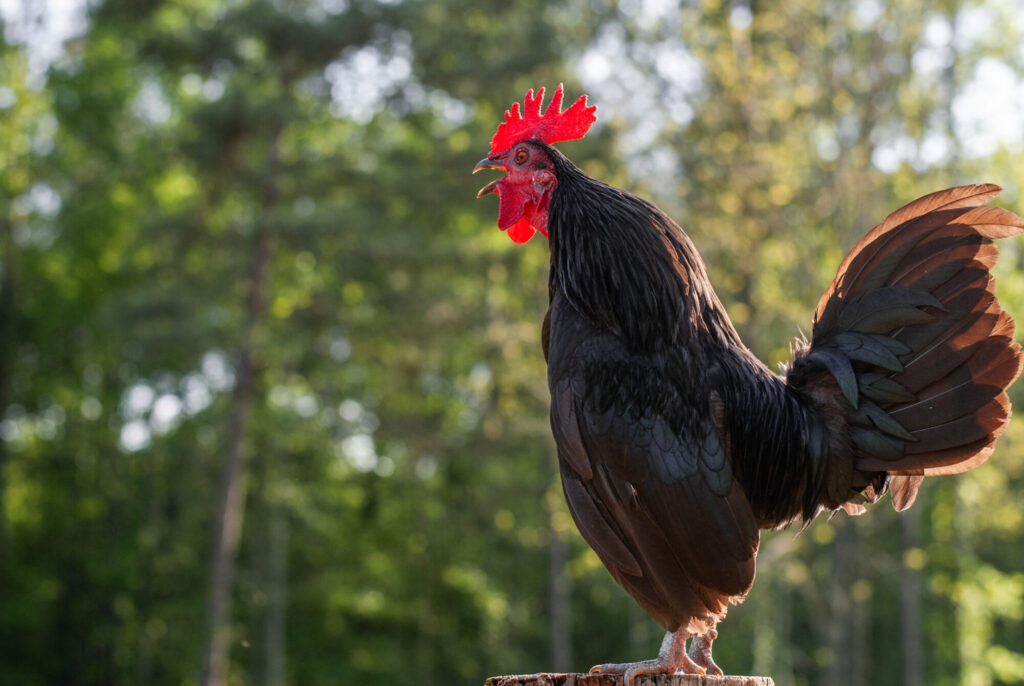
How Many Hens Should You Have Per Rooster?
A general starting point for how many hens you need for each rooster in your flock is 8-12 hens.
However, it’s important to know that the number isn’t that cut and dry. There are many different factors that can influence the number of roosters you need.
Some of these factors are:
- rooster temperament
- flock size
- space
- whether chickens free-range
- number of roosters
- breed/individual personality
- whether you’re trying to hatch fertile eggs
The general rule
1 rooster: 8–12 hens
| Number of Roosters | Approximate Number of Hens |
| 1 | 8–12 |
| 2 | 16–24 |
| 3 | 24–36 |
| 4 | 32–48 |
This is just a starting point, but not a hard rule. Chickens do not know their limits, and each rooster has a different personality.
Some roosters will happily manage a flock with other roosters, and others will cause you problems even with the correct ratios.
Why Does the Hen-to-Rooster Ratio Matter?
I personally love having roosters in my flock. They maintain order among the girls, and are also great at warning the flock of danger.
However, there are two main concerns regarding having a rooster in your flock, as well as the ratio of roosters to hens.
Fertility
If your goal is to hatch your own chickens at home, you most definitely need a rooster to accomplish that.
Your hens will still lay eggs without a rooster, but they won’t be fertilized.
One healthy rooster can fertilize many hens within your flock.
A hen doesn’t have to be mated daily for her eggs to be fertile. She will have fertilized eggs for 7 to 14 days after mating.
This means, as long as your rooster is able to mate with her weekly, her eggs will be fertilized.
Preventing Overbreeding
While one rooster can fertilize a lot of hens, you could have too few hens in your flock.
Too few hens with an active, healthy rooster will lead to the same ones being mated repeatedly.
Overmating can harm your girls and disrupt the peace in your flock.
Overmating causes:
- feather loss
- broken or damaged feathers
- bare backs
- skin irritation
- wounds
- stress
- hens avoiding the rooster
The takeaway is that having more hens than the ratio suggests is always better than too few.
What Happens If You Don’t Have Enough Hens for a Rooster?
As I mentioned before, having too few hens can lead to overmating in your flock.
Overmating will lead to problems with your hens and can ultimately decrease their fertility.
Which could be the main reason you’re keeping a rooster
For example, if you have:
1 rooster + 2–4 hens
Potential problems:
- excessive mating
- feather loss
- damaged backs
- stress
- hens hiding from the rooster
- injuries
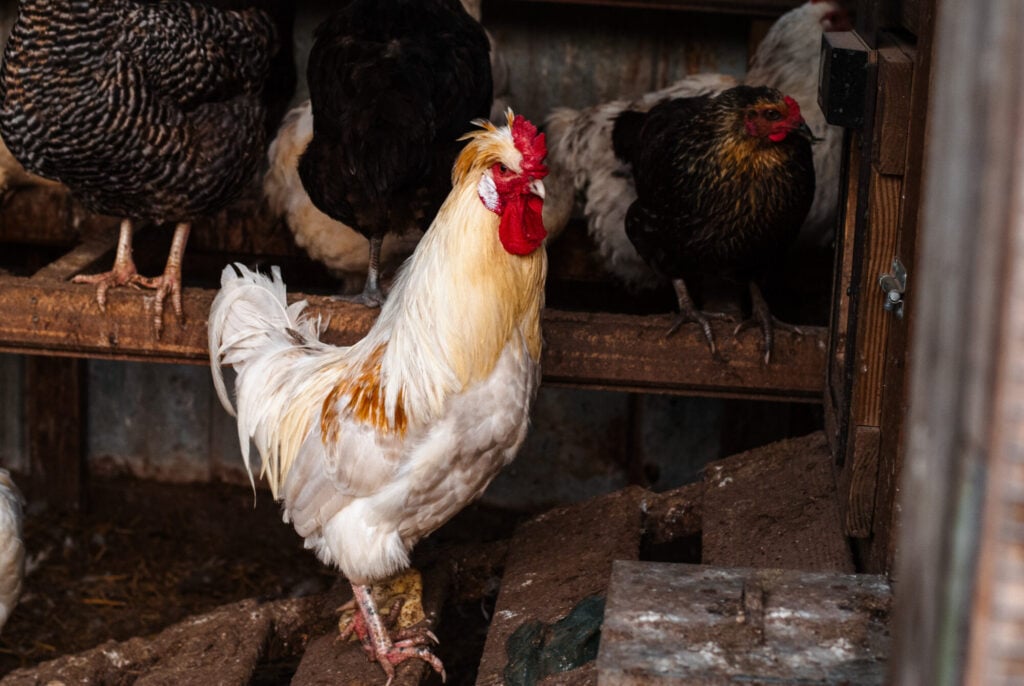
Signs Your Rooster Is Over-Mating Your Hens
Here are some signs that your hens are being overmated.
- Bald or thinning feathers on the lower back
- Broken saddle feathers (around her tail)
- Scratches or wounds- check under her wings, as this is the point the rooster spurs will often penetrate.
- Skin irritation
- Hens constantly running from or hiding from the rooster
- One or two hens receiving most of the attention- roosters definitely have their favorites, and some girls will get mated more than others.
- Hens appearing stressed around the rooster.r
It’s important to note that just because your hens have feathers missing from their backs doesn’t mean they are being overmated.
It could mean there is a parasite problem, molting, or bullying.
Find out more about how to prevent bullying here.
Does the Rooster’s Temperament Matter?
The rooster’s temperament matters more than the actual numbers do. Some roosters behave more aggressively than others do.
If you have an aggressive rooster, he will try to persistently mate your girls. He will also attack other roosters in the flock.
Younger roosters are more prone to this behavior than others. As roosters age, they will tend to not mate as aggressively, although this isn’t always the case.
Each rooster has his own unique personality. Breed can have a lot to do with it as well. For example, Rhode Island Red roosters tend to be more aggressive than docile Buff Orpingtons.
You can have the exact same number of hens with different roosters, and they will treat them completely differently.
A Calm Rooster vs. An Aggressive Rooster
Here is a visual of how differently a calm rooster and an aggressive rooster can act.
| Calm Rooster | Problematic Rooster |
| Allows hens to move freely | Constantly pursues hens |
| Watches flock | Constantly mounts |
| Doesn’t harass hens | Hens avoid him |
| Integrates well | Causes injuries/stress |
An aggressive rooster isn’t necessarily a protective one. Very calm roosters can still be protective. It’s important to monitor their behavior towards the hens in the flock.
Does Flock Size Change the Ideal Ratio?
Yes, flock size will change how many roosters you can have per hen. In a larger flock, hens will be able to get away or hide.
A rooster in a larger flock will also have his attention distracted by many different birds. While he’ll still have favorites, they won’t be as obvious in a larger flock.
The flock dynamics will change a lot too. If you have multiple roosters and multiple hens, there will ultimately be one rooster at the top of the “pecking order”.
However, I have found that even with a large flock and multiple roosters, the flock will tend to break up into smaller flocks. Certain hens will stick with certain roosters. It’s like having mini flocks within the bigger flock.
Again, this dynamic will depend on your particular rooster’s personality. An aggressive rooster will still cause problems, even in a large flock.
Watch your flock closely for signs of bullying and aggressiveness.
Does Free-Ranging Change the Hen-to-Rooster Ratio?
Whether you free-range your flock or have them in a chicken coop will be a personal decision with a lot of different factors considered.
I personally free-range my flock during the day, and secure them in a coop in the evenings.
While free-ranging opens the flock up to predators, it does influence your rooster-to-hen ratios.
In a free-range flock, hens have more places to hide, and more room to escape. They can avoid aggressive roosters or the ones they don’t like altogether.
If you keep your flock in a coop, they are less likely to escape a rooster that is overmating them.
This can also lead to fights between roosters as well as bullying. I personally have had problems with bully roosters in the past because they were confined to a coop.
Free-ranging allows them to claim their territory, if you will.
Keep in mind, space doesn’t fix aggressive rooster problems, but it can help to control it.
Can You Have More Than One Rooster?
Yes, you can have more than one rooster in a flock. They can live peacefully together.
However, their ability to live peacefully together will depend on:
- The number of hens
- The space they have
- Their individual temperament
- Their age
- If they were raised together.
I have successfully raised multiple roosters in my flock for many years. Inevitably, there are dominant ones, but the other boys will fall in line.
What Happens When You Have Multiple Roosters?
When you have multiple roosters,s they will establish a pecking order. Generally,y this is a comical standoff with heads now, and feathers fluffed.
However, it can become very aggressive. I’ve had a rooster lose an eye to a bully rooster.
They can have severe mating competition, especially in the spring, which will injure your hens.
It’s best if the roosters grew up together as chicks, or if a new rooster is introduced as a young cockerel.
Learn more about how to add chickens to your flock.
Can Two Roosters Live Together Without Fighting?
Yes, but not always.
Again, it’s going to depend on their individual temperament and whether they grew up together.
Watch your roosters closely and make sure no one is getting picked on severely.
I have also found that they tend to work things out on their own given enough space.
How Many Hens Do You Need for Two Roosters?
Deciding how many hens you need for two roosters will depend on the temperament of the roosters as well as your hen behavior.
For example, you wouldn’t necessarily double the 10 rule.
A flock of 20 hens could be too few for certain roosters.
For two roosters, a flock of 25-30 would ensure they have enough ladies to keep them happy without overmating or bullying.
The flock will tend to divide itself up into mini flocks.
The number will also depend on their living conditions. Free-range chickens will have more space,e so a small number of hens might work out.
If your flock is confined to a coop, you will need more hens to keep the roosters occupied.
What Should You Do If You Have Too Many Roosters?
Sadly, having too many roosters is a problem that can only be fixed by removing some.
There are several options when it comes to getting your rooster numbers down.
Option 1: Separate a rooster
- If you’re keeping chickens as pets, you can create a bachelor coop for boys only.
- Divide your current run up and put some of your roosters in the second run during the day.
Option 2: Rehome
While rehoming a rooster isn’t easy, some people might want to add one to their flock. Be sure to be honest when you are discussing the rooster’s behavior with his potential new owners.
Option 3: Keep a rooster separately
If you have enough space, relocate your roosters to another portion of your property. This will keep them from influencing the entire flock.
Option 4: Process the extra roosters
Processing young roosters is an option and one that will help to nourish your family.
This isn’t a savory idea for some, but if you want to have a self-sustaining homestead, this is a great way to benefit from your extra guys.
Should You Add More Hens to Fix an Over-Mating Problem?
If you have an aggressive rooster, adding more hens isn’t going to fix his behavior. Unfortunately, there isn’t much you can do about a rooster’s individual personality.
Adding more hens might help to distract him from focusing on his favorites, but it will not be the best answer to the problem.
Before adding more hens to your flock, consider:
- rooster temperament
- inadequate space
- one particular hen being targeted
- flock hierarchy
Sometimes getting rid of the aggressive rooster is a better solution than adding more hens.
How Do You Know If Your Rooster-to-Hen Ratio Is Working?
In order to determine whether or not you have enough hens in your flock, don’t look at numbers alone.
Instead, observe your flock’s behavior.
A Thriving Flock Will Have:
- hens moving freely
- no injuries
- no feather damage
- hens eating/drinking normally
- rooster interacting appropriately
- no hens constantly hiding
- no excessive fighting
Your flock’s behavior will tell you more about whether your not your ratio is working than your numbers will.
Be sure to closely observe them when adding roosters.
Frequently Asked Questions
Is 10 hens to 1 rooster a good ratio?
While this is the standard, it’s not necessarily always going to work. The number of hens a rooster needs will depend on his individual personality.
Can one rooster have 20 hens?
Yes, one rooster can fertilize 20 hens. Hens will stay fertile for up to 14 days. This means your rooster doesn’t have to mate with each hen every day.
Is 5 hens enough for one rooster?
This will depend on your individual rooster’s temperament. A calm rooster might work with 5 hens, but a more aggressive rooster might lead to overmating with so few hens.
Can you have 2 roosters with 10 hens?
Again, this will depend on your individual rooster’s temperament and the conditions they are being kept in.
Can you have multiple roosters in one flock?
Yes, you can have multiple roosters in one flock. Especially in free-ranging flocks where they have plenty of space.
Do hens need a rooster to lay eggs?
No, hens do not need a rooster to lay eggs. However, they do need a rooster in order to have fertile eggs.
How do you know if a rooster is mating hens too much?
Monitor your hens’ behavior to determine if they are being overmated. Hens that are being overmated will have feather loss on the lower portion of their back as well as injuries under their wings.
They will also be scared and avoid the aggressive rooster.
Should I get more hens if my rooster is over-mating them?
Adding more hens will not necessarily fix the problem of overmating. Sometimes an aggressive rooster needs to be removed from the situation.
Can two roosters live together?
Yes, two roosters can live together. This will depend on their individual temperament. If they are aggressive and fighting, it is best to separate them.
Raising them together while they are young will help them to live more comfortably together.
What do you do with extra roosters?
You can separate your roosters into a bachelor pad, re-home unwanted roosters, or harvest your extra roosters for your own nutrition.
More Chicken Keeping Articles You’ll Love
- How Much Water do Chickens Drink in a Day?
- Why Did My Chickens Stop Laying Eggs? 10 Common Reasons
- The Real Cost To Raise 25 Chickens for Meat
- How Much Freezer Space Do You Need For Meat Chickens
Final Thoughts
There’s nothing magical about the number 10. It’s a useful starting point, but your chickens will tell you whether the ratio is working.
Pay attention to your hens, give them enough space to get away from an overly enthusiastic rooster, and don’t be afraid to change your flock setup if someone is getting hurt.
Start with the one-to-ten ratio and observe your flock’s personal needs.
If you enjoyed this article, please share it!
My Favorite Chicken Keeping Supplies
More From The Farm
Have you ever gone to your coop expecting eggs and found none? If you have, you’re wondering “why did my chickens stop laying eggs?”
Turns out, chickens can stop laying eggs for many reasons, and not all of them mean something is wrong. The reasons include shorter daylight, molting, heat, stress, age, broodiness, nutrition, illness, and even hidden nests can all cause egg production to decrease or stop.

Leave a Reply